MindManager vs. Miro (vs. Infinity Maps):
Which Visual Thinking Tool Fits Your Workflow in 2026?
If you’re comparing MindManager and Miro for your visual collaboration needs, you’re likely wrestling with a fundamental choice about how your team organizes and shares knowledge. MindManager promises structured mind mapping with enterprise-grade project management. Miro offers an infinite collaborative whiteboard with real-time teamwork at its core.
But here’s what most comparisons miss: Both tools lock you into a single visualization paradigm when what you really need is the ability to combine multiple approaches.
The real questions you should be asking are:
- Do you have to choose between structured hierarchies and creative freedom?
- Why can’t you have both deep organization and broad connectivity?
- Are you hitting the limits of mind maps with complex interrelations?
- Is your whiteboard becoming an unstructured mess at scale?
- Would you rather be locked into one visualization method or have the flexibility to combine them all?
In short, here’s what we recommend:
👉
MindManager is the power tool for professionals who need structured visual thinking combined with robust project management. Its mind mapping capabilities, Gantt charts, and deep Microsoft Office integration make it ideal for project managers and consultants managing complex initiatives. However, MindManager’s tree structure becomes constraining when you need to show multiple interrelations between ideas. Also, large maps with hundreds of branches lose their elegance and navigability. Starting at $99/year for web-only, $179/year for desktop.
👉
Miro dominates as the collaborative whiteboard for distributed teams who prioritize real-time teamwork. With its large canvas, extensive template library, and 150+ integrations, it’s perfect for design sprints, workshops, and agile ceremonies. Yet Miro’s flat canvas lacks true hierarchy, as everything exists on one layer without the ability to navigate deeply into details or create meaningful intermediate levels. Per-user pricing at $8-16/month quickly escalates for larger teams.
Both platforms force you to choose a single paradigm. Mind maps constrain you to tree structures. Whiteboards lack deep hierarchy. What if you didn’t have to choose?
👉
Infinity Maps represents the evolution beyond traditional visualization paradigms. Like whiteboards, but structured. Like mind maps, but scalable. Like Google Maps, but for ideas. Built on the scientifically-developed iMapping method from the FZI Research Center for Information Technology, it’s the first platform to successfully combine hierarchy (like mind maps), network structures (like concept maps), and free placement (like whiteboards) into one unified visualization approach. With infinite nesting, a zoom factor of 1:1,000,000,000,000, and on-demand connection display that prevents visual overwhelm, it handles complexity that would break traditional tools. At €7.99/month for Pro (€79.99/year annually), with lifetime licenses from €399.
If you’re ready to move beyond the limitations of single-paradigm tools, see how Infinity Maps transforms visual thinking.
Table of contents:
- MindManager vs. Miro vs. Infinity Maps at a glance
- The paradigm problem: Why you shouldn’t have to choose
- MindManager: When mind maps hit their limits
- Miro: The flat canvas ceiling
- Infinity Maps: The paradigm combination advantage
- Scientific foundations matter
- Pricing models and target audiences
- Integration philosophies
- Performance at scale
- MindManager vs Miro vs Infinity Maps: Which should you choose?
MindManager vs. Miro vs. Infinity Maps at a glance
Here’s the fundamental difference: two platforms lock you into single paradigms, while one combines them all.
|
MindManager |
Miro |
Infinity Maps |
| Core Philosophy |
Mind mapping with project management |
Collaborative whiteboard |
Paradigm fusion: hierarchy + network + freedom. (incl. collaboration) |
| Starting Price |
$99/year (Essentials) |
$96/year ($8/month) |
€79.99/year (€7.99/month) |
| Free Version |
30-day trial |
Unlimited users, 3 boards |
3 maps, 300 cards (no time limit) |
| Max Hierarchy Levels |
~10 levels |
~4 levels |
>100 levels |
| Zoom Factor |
1:10 |
1:500 |
1:1,000,000,000,000 |
| Cross-connections |
★★Limited, becomes messy |
★★★Yes, but confusing at scale |
★★★★★On-demand display for complex structures |
| Structure |
★★★★Tree hierarchies only |
★★Flat canvas |
★★★★★Multiple paradigms |
| Collaboration |
Real-time co-editing |
Built for teams |
Real-time co-editing, various sharing modes |
| Scientific Foundation |
Traditional mind mapping |
Whiteboards |
iMapping method based on scientific research (see below) |
| Best For |
Project managers locked into trees |
Teams needing flat collaboration |
Knowledge workers who’ve outgrown single paradigms |
The paradigm problem: Why you shouldn’t have to choose
Traditional visualization tools force an impossible choice: pick your paradigm and live with its limitations.
Mind mapping emerged from Tony Buzan’s work on radial thinking, creating a powerful but constrained approach. Everything branches from a central node in a tree structure. This works beautifully for hierarchical information, but what happens when you need to show that multiple branches support the same conclusion? Or when contradictory evidence needs to be visualized? Add more than five cross-connections to a mind map and you get visual spaghetti.
 Source: Wikipedia
Whiteboards took the opposite approach by offering complete freedom on an infinite canvas. But freedom without structure becomes chaos. When you have hundreds of elements on a Miro board, they’re all at essentially the same level. You can group them visually, but you can’t zoom into a sticky note and find an entire sub-board with its own hundreds of elements. The lack of true hierarchy means complex projects inevitably become unwieldy.
The
iMapping method, developed through scientific research at the IWM Leibniz Institute for Knowledge Media in Tübingen and FZI Research Center for Information Technology in Karlsruhe, Germany, recognized that human knowledge doesn’t fit neatly into either paradigm. Sometimes you need strict hierarchy. Sometimes you need free association. Often you need both simultaneously. This isn’t just software innovation; it’s the application of cognitive science to information management.
MindManager: When mind maps hit their limits
MindManager has perfected the mind map paradigm, but perfection within constraints is still constrained.
The platform excels at what mind maps do well: organizing information into clear hierarchical trees. The
Gantt charts, project management features, and
deep Microsoft Office integration make it invaluable for structured project planning. You can transform a brainstorm into a project timeline with dependencies and resource allocations.
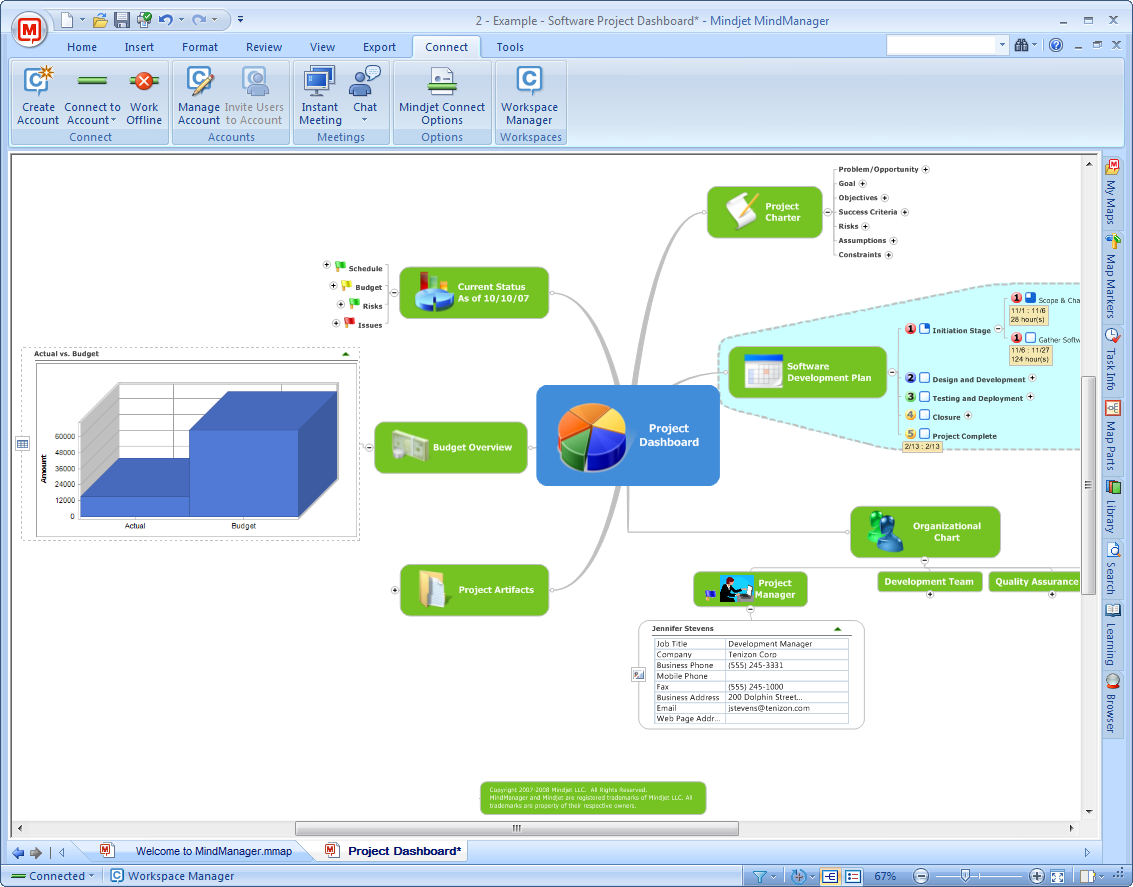
But here’s where the paradigm breaks: Mind maps work beautifully until they don’t. Users report that maps with hundreds of sub-branches become impossible to navigate effectively. When fully zoomed out, you can’t read even the top-level branches. When zoomed in, you lose context and orientation. The zoom factor of roughly 1:10 means you’re always choosing between overview and detail, never having both.
More critically, mind maps fail when information isn’t strictly hierarchical. Try showing that multiple factors contribute to a single outcome, while also influencing each other. Attempt to visualize contradictory evidence. Add interrelations between different branches. The tree structure that makes mind maps powerful becomes their prison. Even though
MindManager technically allows relationship lines, more than a handful turns your elegant tree into an incomprehensible tangle.
The
mobile experience remains essentially read-only, and at 213,- €/year for the full desktop version, you’re paying premium prices for a tool that may constrain your thinking as much as it organizes it.
Miro: The flat canvas ceiling
Miro has revolutionized collaborative whiteboards, but its flat architecture creates fundamental limitations for complex information management.
The platform’s genius lies in real-time collaboration. Multiple cursors, instant updates,
built-in video chat—it genuinely feels like working around a physical whiteboard together. The
5,000+ templates and
150+ integrations make it incredibly versatile for workshops and sprints.
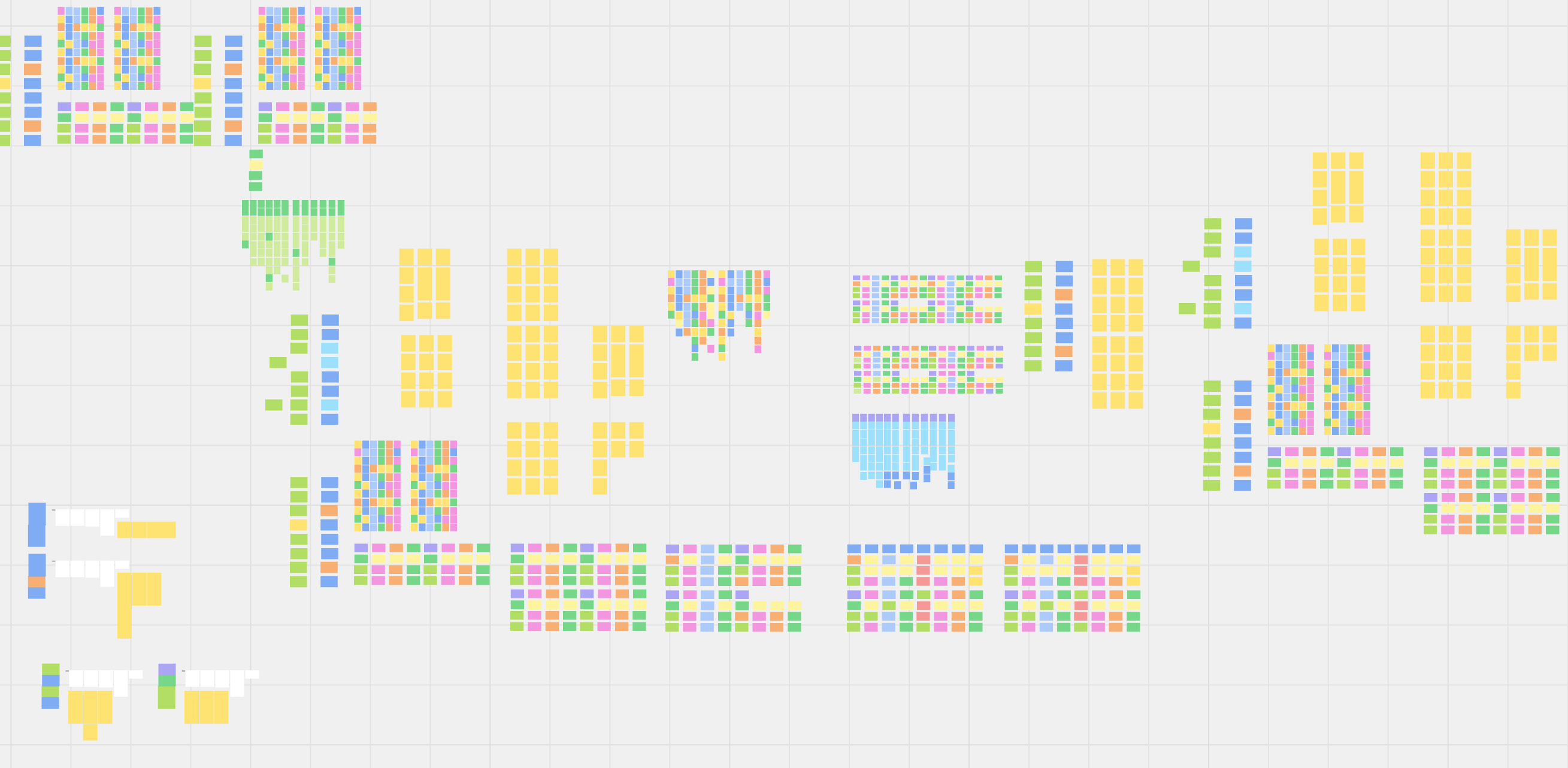
But Miro’s strength becomes its weakness at scale. Everything exists on one flat layer. You can’t zoom into a sticky note and find another complete board inside. The hierarchy is limited to about four levels through frames and groups, but these are visual organizing principles, not true nested structures. When your board grows to hundreds or thousands of elements, they’re necessarily at similar levels without depth making clear overall structure impossible.
Performance degrades noticeably around 1,000 objects, with serious issues approaching 5,000.This isn’t just a technical limitation because it reflects the fundamental challenge of managing complex information on a flat surface. You can organize visually, but you can’t create the deep, navigable hierarchies that complex knowledge requires.
The
per-user pricing model ($8-16/month) means a 20-person team pays $3,840/year for what is essentially a very sophisticated flat canvas. For teams that need structure with their collaboration, that’s an expensive limitation.
While Miro might offer a more polished start with mature features, once teams realize they’re hitting its structural limits, migration becomes difficult. Your investment in organizing information on a flat canvas doesn’t translate well to other paradigms. Consider starting with a platform that won’t constrain your future growth.
Infinity Maps: The paradigm combination advantage
Infinity Maps doesn’t ask you to choose between paradigms; instead, it combines them all into something genuinely new.
Our platform’s signature innovation is
infinite nesting with paradigm fusion. Unlike MindManager’s trees or Miro’s flat canvas, any card can contain an entire sub-map with hundreds of elements. That sub-map can have its own nested maps, creating potentially infinite depth with over 100 hierarchy levels possible. But here’s the breakthrough: You’re not constrained to tree structures. You can show unlimited interrelations between any elements at any level.

The on-demand connection display solves the visual complexity problem elegantly. Instead of showing all connections at once (creating spaghetti), connections appear only for selected or hovered elements. This means you can have hundreds of interrelations in your map without visual overwhelm—the connections are there when you need them, hidden when you don’t.
The zoom factor of 1:1,000,000,000,000 isn’t just a big number because it represents a fundamentally different approach to information navigation. You can zoom from planetary overview to microscopic detail smoothly, maintaining context at every level. It’s literally like Google Maps for your knowledge, where you can see the entire country or zoom into a single street, with meaningful intermediate levels throughout.
This isn’t just about adding features; it is a new paradigm. Within the same map, you can have:
- Strict hierarchies where needed (like MindManager)
- Free-form creative areas (like Miro)
- Complex networks with multiple interrelations (like concept maps)
- Spatial organization with meaning (like spatial hypertext)
The platform also serves as an overview layer for existing systems. You don’t need to migrate everything; you can leave documents in SharePoint, tickets in Jira, and use Infinity Maps to create a visual navigation system across all your tools.
At
79.99 €/year, it’s priced below both competitors while offering fundamentally more capability. The
lifetime license option from 399,- € shows confidence in long-term value.
Scientific foundations matter
While MindManager and Miro evolved from practical needs, Infinity Maps emerged from cognitive science research.
The iMapping method behind Infinity Maps was developed through years of research at prestigious institutions such as the IWM Leibniz Institute for Knowledge Media in Tübingen and the FZI Research Center for Information Technology in Karlsruhe. This isn’t marketing fluff; it is peer-reviewed, award-winning research into how humans actually process and navigate complex information.
The research identified why existing tools fail: They force artificial constraints on naturally multi-dimensional thinking. Mind maps impose tree structures on networked knowledge. Whiteboards provide space without structure. Note-taking tools offer hierarchy without visualization. Each tool makes you adapt your thinking to its paradigm rather than adapting to how you think.

The iMapping method combines the proven benefits of:
- Mind maps (hierarchical organization)
- Concept maps (relationship visualization)
- Graphs (network structures)
- Whiteboards (spatial freedom)
- Spatial hypertext (meaningful positioning)
This scientific approach created something users describe as “the starting page for my brain,” which is a tool that works with human cognition rather than against it. The smooth zooming, contextual navigation, and on-demand complexity management aren’t just features; they’re implementations of cognitive principles about spatial memory and information processing.
Pricing models and target audiences
The pricing structures reveal each platform’s true target audience and philosophy.
MindManager‘s pricing reflects traditional software thinking.
Starting at 117,81€/year for web-only Essentials, jumping to 213,01 €/year for Professional desktop features, or a
one-time purchase around 413 €. This positions it as serious business software for serious budgets, targeting enterprises already invested in the Microsoft ecosystem.
 Miro
Miro‘s
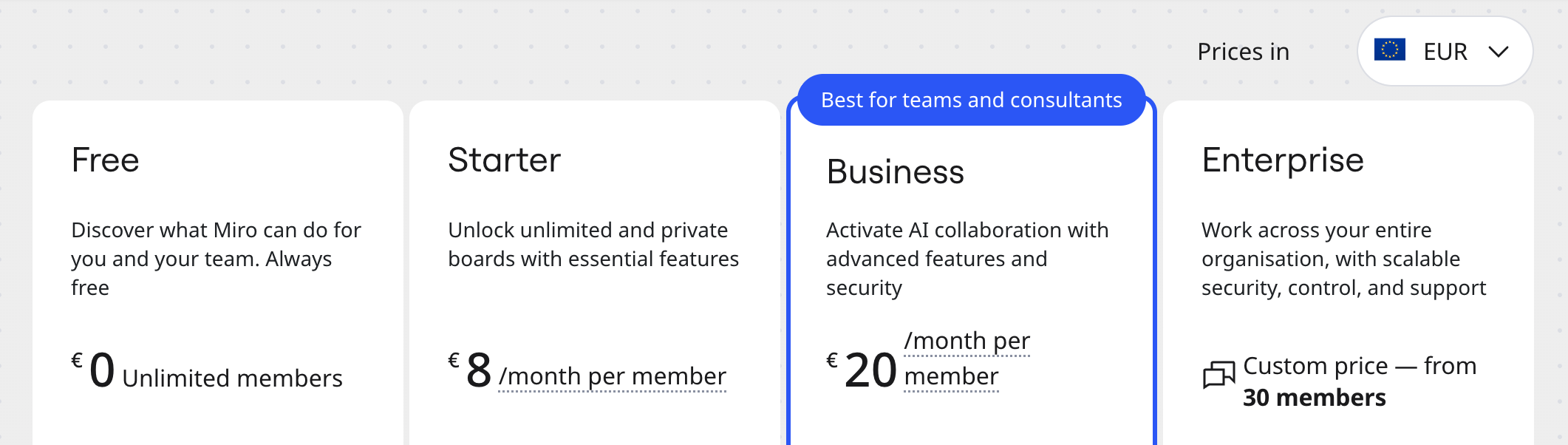
per-user model starting at $8/month seems reasonable until you scale it. A 50-person company could spend $9,600/year. This enterprise-focused pricing assumes the value of real-time collaboration justifies the cost, which makes sense for companies running constant workshops and design sprints.
 Infinity Maps
 takes a refreshingly different approach.
€7.99/month for Pro includes 10 maps with 1,500 cards each. €14.99/month for Unlimited removes all restrictions. The
lifetime license option from €399 is particularly interesting because it promises all future updates for a single one-off payment.

The original focus of the iMapping approach, to help individual knowledge workers with their every day information struggles, solves traditional knowledge management adoption problems: When experts use it for their own benefit by managing their research, organizing their thoughts, and getting an overview of their projects, sharing with teams becomes natural rather than forced.
Integration philosophies
Each platform’s integration strategy reveals their fundamental priorities.
MindManager doubles down on Microsoft with
deep connections to Project, SharePoint, and Excel. The Data Mapper creates sophisticated visualizations from spreadsheet data. They also offer
Zapier integration, but the focus is clear: they’re building for the Microsoft-centric enterprise.
 Miro
Miro takes the opposite approach with
150+ integrations covering everything from Slack to Adobe Creative Suite. Their
Microsoft Teams integration allows boards embedded directly in channels. This breadth-over-depth strategy reflects their platform-agnostic, collaboration-first philosophy.
 Infinity Maps currently has limited integrations
, but this reflects a different philosophy: Perfect the core experience first. More importantly, we position ourselves as an overview layer for existing tools. You don’t need deep integration because your map can link to and organize resources across all platforms, becoming the visual navigation system for your entire digital workspace.
Performance at scale
How each platform handles growth reveals their architectural limits and design philosophies.
MindManager, as desktop software, handles large maps well initially. But the mind map paradigm itself breaks down because maps with hundreds of branches become unnavigable regardless of technical performance. The ~10 level hierarchy limit and 1:10 zoom factor mean you’re always sacrificing either overview or detail.
Miro‘s cloud architecture creates predictable scaling challenges.
Boards slow noticeably around 1,000 objects and hit limits around 5,000. But the real limitation isn’t technical—it’s conceptual. Without true hierarchy, thousands of elements on one flat layer become impossible to organize meaningfully.
Infinity Maps faces unique challenges with infinite nesting but solves them through on-demand loading and intelligent rendering. Our platform can handle thousands of elements while maintaining performance because you only load what you’re viewing. The 1:1,000,000,000,000 zoom factor means you can organize massive amounts of information across multiple scales without everything existing at once.

MindManager vs. Miro vs. Infinity Maps: Which should you choose?
The choice isn’t really about features. It’s about whether you want to be locked into a single visualization paradigm.
Choose MindManager if:
- You’re committed to the mind map paradigm despite its limitations
- Microsoft Office integration is absolutely crucial
- You need traditional project management features
- Your information truly fits tree structures
- You can accept the constraints of hierarchical-only organization
If that aligns with your goals, MindManager could be the ideal solution.
Choose Miro if:
- You are happy with moderately sized whiteboards for confined topics
- You can work without deep hierarchy
- Team collaboration features are essential
- You run constant workshops and design sprints
- You’re willing to pay premium per-user pricing
- You can accept performance limits around 1,000-5,000 objects
Power your teamwork and creativity with Miro.
Choose Infinity Maps if:
- You’ve hit the limits of mind maps or whiteboards
- You need to show complex interrelations without visual chaos
- Your information requires both hierarchy and connections
- You want overview from planetary level to microscopic detail
- You believe visualization tools should adapt to your thinking, not vice versa
- You prefer to invest in a tool that won’t constrain your future needs
The most important insight: MindManager perfects mind maps, Miro perfects whiteboards, but both lock you into single paradigms that will eventually constrain your thinking. This is especially true for Miro because it’s hard to migrate once you’re locked in.
Infinity Maps is the only platform that combines all major visualization approaches, letting you use hierarchy where it helps and connections where they matter, all within the same navigable space. Most importantly, it’s completely scalable so you avoid any migration headaches as you grow.
For teams stuck with existing tools, consider Infinity Maps for your next project where you don’t want to discover paradigm limitations after months of investment. For individuals, it’s the cognitive tool that grows from simple note-taking to comprehensive knowledge management without forcing you to switch platforms or change how you think.
Ready to move beyond the limitations of single-paradigm thinking? Experience how Infinity Maps combines the best of all visualization approaches with our free plan—no time limits, no trial expiration.



Kommentare